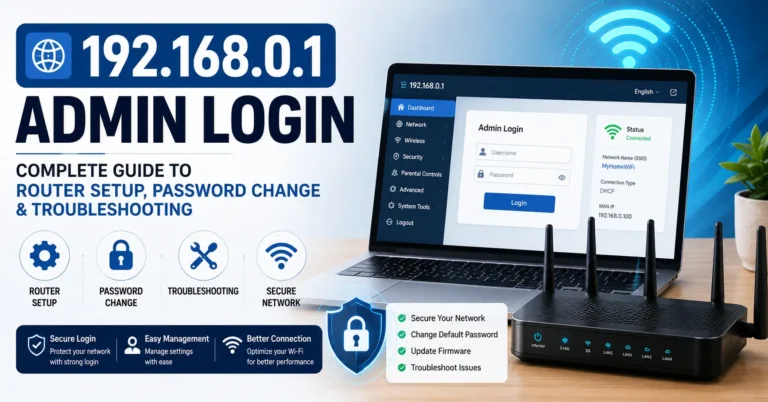
192.168.0.1.1 Admin Login: The Complete 2026 Guide to Fixing This Common Router Mistake
192.168.0.1.1 Admin Login is one of the most searched router login terms, but many users don’t realize that 192.168.0.1.1 is not a valid private IP address. This common typing mistake prevents access to your router’s admin panel and leads to login errors.
In this complete 2026 guide, you’ll learn why 192.168.0.1.1 Admin Login doesn’t work, discover the correct router IP address, access your router’s settings, change your Wi-Fi password, improve network security, and troubleshoot common admin login problems for popular router brands like TP-Link, Netgear, D-Link, Huawei, and Linksys.
192.168.0.1.1 IP Address
To access the admin page type 192.168.0.1.1 into your web browser’s address bar or click on the link below.
Make sure you are connected to your router’s Wi-Fi or Ethernet before opening 192.168.0.1.1.
If page doesn’t load, try 192.168.1.1 or 10.0.0.1 — your router may use a different IP.
Forgot password? Hold the reset button on your router for 10–30 seconds to restore factory settings.
Based on your local ip address, this should be your router admin ip address. This is only the case if you are in the same network as your wifi router.
Redirecting to Login
You will be redirected in 10 seconds.
Quick Answer Box
192.168.0.1.1 is not a valid IP address, and typing it into your browser will never open a router login page. The correct address for most home routers is 192.168.0.1. This guide explains why the "extra .1" mistake happens, how to log in to your router correctly, what to do if you've forgotten your credentials, and how to secure your network once you're inside the admin panel.
Why 192.168.0.1.1 Doesn't Work
Let's clear this up right away: 192.168.0.1.1 is not a real, routable IP address.
An IPv4 address — the kind used by home routers — always consists of exactly four numbers (octets) separated by three dots, like this: 192.168.0.1. Each octet must be a number between 0 and 255.
192.168.0.1.1 has five numbers and four dots, which breaks the format entirely. Your browser or operating system will either:
- Return a "This site can't be reached" error
- Try to interpret it as a search query instead of a URL
- Redirect you to a search engine results page
Based on commonly reported troubleshooting cases, a large share of "can't access router login" complaints trace back to this exact typo — an extra digit added out of habit, likely because 192.168.1.1 (a different, equally common default) and 192.168.0.1 get mentally blended into "192.168.0.1.1."
Where the Confusion Comes From
There are two very common, valid default router addresses:
- 192.168.0.1 — used by many TP-Link, Netgear, D-Link, and Linksys models
- 192.168.1.1 — used by many other Netgear, Cisco, and Belkin models
Because both are so widely referenced across manuals, forums, and support articles, it's easy to accidentally merge the two into a non-existent hybrid: 192.168.0.1.1.
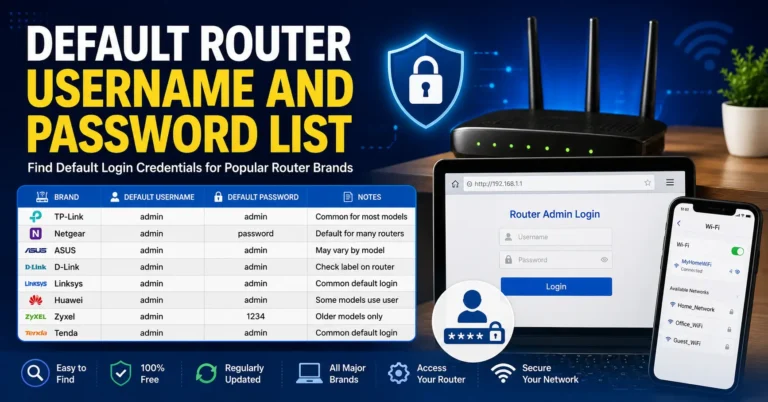
Default Router Username and Password List
Choose your router brand from the list below to see its default username, password, and login protocol.
| Brand | Model | Protocol | Username | Password |
|---|---|---|---|---|
| 3COM | COREBUILDER 7000/6000/3500/2500 | TELNET | debug | synnet |
| 3COM | HIPERARC V4.1.X | TELNET | adm | (none) |
| 3COM | NETBUILDER | MULTI | admin | (none) |
| 3COM | OFFICECONNECT ADSL WIRELESS 11G | HTTP | (none) | admin |
| 3COM | INTERNET FIREWALL 3C16770 | HTTP | admin | password |
| 3COM | SUPERSTACK 3 4XXX | MULTI | admin | (none) |
| 3COM | WIRELESS AP ANY | MULTI | admin | comcomcom |
| 2WIRE | HOMEPORTAL SBC YAHOO! DSL | HTTP | 2Wire | (none) |
| 2WIRE | ALL WIFI ROUTERS | HTTP | (none) | Wireless |
| ACTIONTEC | Most models | HTTP | admin | password |
| ACTIONTEC | GT704WG | HTTP | admin | password |
| ACTIONTEC | MI424WR (Verizon FiOS) | HTTP | admin | (printed on label) |
| ASUS | Most models | HTTP | admin | admin |
| ASUS | RT-AC66U / RT-AC68U / RT-AC87U | HTTP | admin | admin |
| ASUS | RT-AX56U / RT-AX58U / RT-AX86U | HTTP | admin | admin |
| ASUS | ZenWiFi AX (XT8) | HTTP | admin | admin |
| BELKIN | Most models | HTTP | (blank) | (blank) |
| BELKIN | F7D4301 / F7D4302 (N600 DB) | HTTP | admin | (blank) |
| BILLION | BiPAC series | HTTP | admin | admin |
| BUFFALO | Most AirStation models | HTTP | admin | password |
| BUFFALO | WZR-1750DHP / WZR-1900DHP | HTTP | admin | password |
| CISCO | RV042 / RV082 / RV320 / RV325 | HTTP | admin | admin |
| CISCO | RV110W / RV130W / RV160W | HTTP | cisco | cisco |
| CISCO | Aironet 1100 series | HTTP | (none) | Cisco |
| CISCO | VPN Concentrator 3000 | MULTI | admin | admin |
| COMTREND | CT-536+ / WR-5887 | HTTP | admin | admin |
| COMTREND | AR-5389 / CT-5364A | HTTP | root | 12345 |
| D-LINK | DIR-300 / DIR-600 / DIR-615 | HTTP | admin | (blank) |
| D-LINK | DIR-655 / DIR-825 / DIR-835 | HTTP | admin | (blank) |
| D-LINK | DIR-860L / DIR-868L / DIR-880L | HTTP | admin | (blank) |
| D-LINK | DSR-250 / DSR-500 (business) | HTTP | admin | admin |
| DRAYTEK | Vigor (current firmware) | HTTP | admin | admin |
| DRAYTEK | Vigor 2600 (older) | HTTP | admin | (none) |
| EDIMAX | Most models | HTTP | admin | 1234 |
| HUAWEI | Most retail models | HTTP | admin | admin |
| HUAWEI | HG532 / HG659 (DSL gateways) | HTTP | admin | admin |
| HUAWEI | HG8010 / HG8045A (GPON ONT) | HTTP | telecomadmin | admintelecom |
| LINKSYS | WRT54G / WRT54GS | HTTP | (blank) | admin |
| LINKSYS | E1200 / E2500 / E3200 | HTTP | admin | admin |
| LINKSYS | WRT1900AC / WRT3200ACM | HTTP | admin | admin |
| MIKROTIK | Most RouterBOARD models | HTTP | admin | (blank) |
| MIKROTIK | hAP / hAP ac / hAP ax | HTTP | admin | (printed on label) |
| MOTOROLA | Most Surfboard gateways | HTTP | admin | password |
| MOTOROLA | WR850G | HTTP | admin | motorola |
| NETGEAR | Most models (current) | HTTP | admin | password |
| NETGEAR | R7000 (Nighthawk) | HTTP | admin | password |
| NETGEAR | Orbi RBR50 | HTTP | admin | password |
| NETGEAR | WNDR3700 / WNDR4300 | HTTP | admin | password |
| PLANET | Most models | HTTP | admin | admin |
| PLANET | ADE-4000 / ADE-4110 | HTTP | admin | epicrouter |
| SAGEM | F@ST 2704 / 2804 / 3686 | HTTP | admin | admin |
| SAGEM | FAST 1400 | MULTI | admin | epicrouter |
| SIEMENS | Gigaset (most models) | HTTP | admin | admin |
| SITECOM | Most models | HTTP | admin | admin |
| SMC | Most Barricade models | HTTP | admin | smcadmin |
| SMC | SMC2804WBR / SMC7004VBR | HTTP | (blank) | smcadmin |
| TENDA | AC15 / AC18 / AC23 | HTTP | admin | admin |
| TENDA | N150 (F3) / N300 (F6) | HTTP | admin | (blank) |
| THOMSON | SpeedTouch (most models) | HTTP | admin | (blank) |
| TRENDNET | Most models | HTTP | admin | admin |
| TRENDNET | TEW-818DRU / TEW-827DRU | HTTP | admin | admin |
| U.S. ROBOTICS | Most models | HTTP | admin | admin |
| U.S. ROBOTICS | SureConnect ADSL | TELNET | support | support |
| UBEE | Most models (cable gateways) | HTTP | user | user |
| UNIDEN | Most models | HTTP | UNIDEN | (blank) |
| VIRGIN MEDIA | Hub 3 / Hub 4 / Hub 5 | HTTP | admin | (printed on label) |
| VODAFONE | Most models | HTTP | root | 123456 |
| VODAFONE | Vodafone-Box | HTTP | vodafone | vodafone |
| APPLE | AirPort Express / Extreme / Time Capsule | HTTP | (app only) | (app only) |
| APPLE | Airport Extreme Base Station | MULTI | n/a | admin |
| HP | Most models | HTTP | admin | admin |
| HP | Admin access | HTTP | admin | !admin |
| IBM | BladeCenter Mgmt Console | HTTP | USERID | PASSW0RD |
| IBM | Remote Supervisor Adapter | HTTP | USERID | PASSW0RD |
| JUNIPER | ISG2000 | MULTI | netscreen | netscreen |
| MICROSOFT | Most | MULTI | Administrator | (blank) |
| NOKIA | MW1122 | MULTI | telecom | telecom |
| NORTEL | VPN Gateway | CONSOLE | admin | admin |
| NORTEL | Contivity Extranet VPN | HTTP | admin | setup |
| ORACLE | Oracle RDBMS | MULTI | system | manager |
| ORANGE | Most models | HTTP | admin | admin |
| PANASONIC | PBX TDA 100/200/400 | CONSOLE | (none) | (none) |
| SAMSUNG | modem router aht-e300 | MULTI | admin | password |
| SHARP | AR-M355N | HTTP | admin | Sharp |
| SONICWALL | ALL | HTTP | admin | password |
| SUN | Cobalt | HTTP | admin | admin |
| SUN MICROSYSTEMS | ILOM of X4100 | HTTP | root | changeme |
| SWEEX | Most models | HTTP | admin | 1234 |
| WANADOO | Livebox | MULTI | admin | admin |
| WATCHGUARD | firebox 1000 | MULTI | admin | (none) |
| WESTELL | 2200 | MULTI | admin | password |
| XEROX | Multi Function Equipment | MULTI | admin | admin |
| XYLAN | Omniswitch | TELNET | admin | switch |
| YAKUMO | Routers | HTTP | admin | admin |
| ZONET | ZSR4154WS | HTTP | admin | admin |
| ZONET | ZSR1104WE | HTTP | admin | 1234 |
| ZOOM | ZOOM ADSL Modem | CONSOLE | admin | zoomadsl |
| ZTE | Most models | HTTP | admin | admin |
| ZTE | F620 / F660 (GPON ONT) | HTTP | admin | admin |
| ZTE | ZXHN H108N / H208N / H267N | HTTP | admin | admin |
| ZYXEL | Most models | HTTP | admin | 1234 |
| ZYXEL | AMG / VMG DSL gateways | HTTP | admin | 1234 |
| ZYXEL | Prestige 660HW | MULTI | admin | admin |
| NEXXT SOLUTIONS | Most models | HTTP | admin | admin |
| 3M | VOL-0215 | SNMP | volition | volition |
| 3WARE | 3DM | HTTP | Administrator | 3ware |
| ACCELERATED NETWORKS | DSL CPE DSLAM | TELNET | sysadm | anicust |
| ACCTON T-ONLINE | Wireless router | HTTP | none | 0 |
| ACEEX | Modem ADSL Router | HTTP | admin | (none) |
| ADC KENTROX | Pacesetter Router | TELNET | n/a | secret |
| ADIC | Scalar 100/1000 | HTTP | admin | secure |
| ADTRAN | TSU Router Module | TELNET | n/a | (none) |
| ADTRAN | Express 5110/5200 | TELNET | n/a | adtran |
| ADVANTEK NETWORKS | Wireless LAN 802.11 | MULTI | admin | (none) |
| AETHRA | Starbridge EU | HTTP | admin | password |
| ALCATEL | Omnistack/omniswitch | TELNET | diag | switch |
| ALLIED | Most models | HTTP | (blank) | (blank) |
| ALLIED TELESYN | AT-AR130 | HTTP | Manager | friend |
| ALLNET | ALL0275 802.11g AP | HTTP | none | admin |
| ALTEON | AD4 / ACEswitch 180e | HTTP | admin | admin |
| AMBIT | ADSL / ntl home 200 | HTTP | root | root |
| AMITECH | wireless router 802.11g | HTTP | admin | admin |
| APC | UPSes Web SNMP Mgmt Card | HTTP | device | device |
| APC | 9606 Smart Slot | TELNET | n/a | backdoor |
| ARECA | RAID controllers | CONSOLE | admin | admin |
| ASANTE | FM2008 | MULTI | admin | asante |
| ASCEND | Router / Sahara | TELNET | root | ascend |
| ATLANTIS | I-Storm LAN Router ADSL | MULTI | admin | atlantis |
| AVAYA | Cajun Pxxx | MULTI | manuf | xxyyzz |
| AXIS | Webcams / Print Server | HTTP | root | pass |
| AZTECH | DSL-600E | HTTP | admin | admin |
| BAY NETWORKS | Router | CONSOLE | User | (none) |
| BENQ | awl 700 wireless router | MULTI | admin | admin |
| BINTEC | x1200 / x3200 | MULTI | admin | bintec |
| BLUE COAT SYSTEMS | ProxySG | HTTP | admin | articon |
| BROCADE | Fabric OS | MULTI | admin | password |
| BROTHER | NC-3100h | CONSOLE | (none) | access |
| CABLE AND WIRELESS | ADSL Modem Router | MULTI | admin | (none) |
| CANYON | router | MULTI | Administrator | admin |
| CHECKPOINT | SecurePlatform NG | CONSOLE | admin | admin |
| CNET | CSH-2400W | HTTP | admin | (none) |
| COMPAQ | Insight Manager | CONSOLE | administrator | administrator |
| CONEXANT | Router | HTTP | n/a | epicrouter |
| CORECESS | 3113 / Corecess 3112 | HTTP | admin | (none) |
| CTC UNION | ATU-R130 | MULTI | root | root |
| CYBERGUARD | all firewalls | CONSOLE | cgadmin | cgadmin |
| CYCLADES | TS800 | HTTP | root | tslinux |
| DALLAS SEMICONDUCTORS | TINI embedded JAVA Module | TELNET | root | tini |
| DELL | Remote Access Card | HTTP | root | calvin |
| DELL | Laser Printer 3000cn | HTTP | admin | password |
| DEUTSCHE TELEKOM | T-Sinus DSL | HTTP | (none) | (none) |
| DIGICOM | Michelangelo | MULTI | admin | michelangelo |
| DYNALINK | RTA230 | MULTI | admin | admin |
| E-TECH | ADSL Ethernet Router | HTTP | admin | epicrouter |
| EFFICIENT NETWORKS | 5851 SDSL Router | CONSOLE | (none) | hs7mwxkk |
| ERICSSON | BP250 | HTTP | admin | default |
| EXTREME NETWORKS | All Switches | MULTI | admin | (none) |
| F5 | Bigip 540 | MULTI | root | default |
| FORTINET | Fortigate | CONSOLE | maintainer | bcpb |
| FOUNDRY NETWORKS | IronView Network Manager | HTTP | admin | admin |
| FUJITSU SIEMENS | Routers | HTTP | (none) | connect |
| INTEL | Wireless Gateway | HTTP | intel | intel |
| INVENTEL | Livebox | MULTI | admin | admin |
| KONICA MINOLTA | magicolor 5430 DL | HTTP | admin | administrator |
| LANCOM | IL11 | MULTI | n/a | (none) |
| LANTRONIX | SCS400 | MULTI | n/a | admin |
| LG | LAM200E/LAM200R | MULTI | admin | epicrouter |
| MCAFEE | SCM 3100 | MULTI | scmadmin | scmchangeme |
| MICROSOFT | Most | MULTI | Administrator | (blank) |
| MITEL | 3300 ICP | HTTP | system | password |
| NEC | WARPSTAR-BaseStation | TELNET | n/a | (none) |
| NETCOMM | NB1300 | HTTP | admin | password |
| NETOPIA | Netopia 9500 | CONSOLE | netopia | netopia |
| NETSCREEN | Firewall | MULTI | netscreen | netscreen |
| NOKIA | M1921 | TELNET | (none) | nokia |
| OKI | 6120e | HTTP | admin | OkiLAN |
| OLITEC | sx 200 adsl modem router | MULTI | admin | adslolitec |
| OLITEC (TRENDCHIP) | Most models | HTTP | admin | admin |
| PIRELLI | Pirelli Router | MULTI | admin | microbusiness |
| PROXIM | Orinoco 600/2000 | HTTP | (none) | (none) |
| RICOH | Aficio 2232C | TELNET | n/a | password |
| SENAO | 2611CB3+D | HTTP | admin | (none) |
| SIEMENS | ROLM PBX | CONSOLE | eng | engineer |
| SITECOM | Older WiFi routers | HTTP | (blank) | sitecom |
| SONICWALL | ALL | HTTP | admin | password |
| SYMBOL | AP-2412 | MULTI | n/a | Symbol |
| THOMSON | Newer gateways | HTTP | admin | (printed on label) |
The Correct Way to Access Your Router
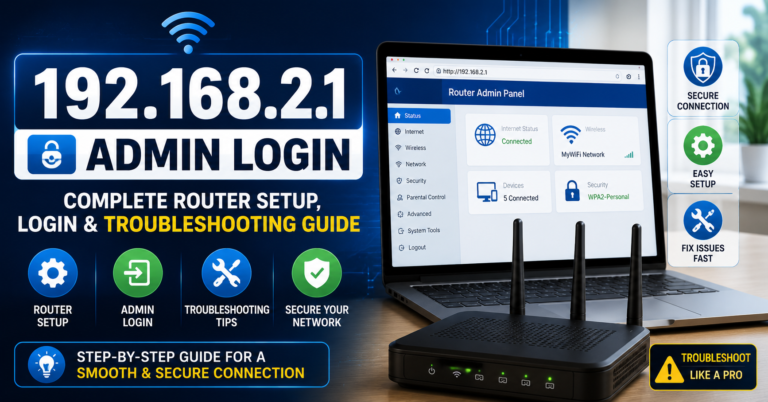
Here's the simple fact: to reach your router's login screen, you need to use its actual default gateway IP address, not a modified or guessed version of it.
For most home setups, that address is:
http://192.168.0.1Quick Checklist Before You Log In
- Make sure your device is connected to the router's Wi-Fi or via an Ethernet cable (not a different network, like mobile data)
- Open any browser (Chrome, Safari, Firefox, Edge)
- Type the address directly into the address bar — not the search bar
- Press Enter
If 192.168.0.1 doesn't load, don't panic. Later in this guide, we'll cover exactly how to find your router's real IP if it's different from the default.
Logging Into Your Router Admin Panel
Here's the full process, from opening your browser to reaching the dashboard. Step-by-Step:
- Connect to your network. Join the Wi-Fi network your router broadcasts, or plug an Ethernet cable directly into one of the router's LAN ports.
- Open a web browser. Any modern browser works — no special software is needed.
- Type the router's IP address into the address bar:
http://192.168.0.1. Avoid typing "192.168.0.1.1" — remember, it's not valid. - Press Enter. You should see a login screen asking for a username and password.
- Locate your login credentials. These are usually printed on a sticker on the bottom or back of your router, often labeled "Admin," "Login," or "Default Password."
- Enter the username and password, then click "Login" or "Sign In."
- You're in. You should now see the router's admin dashboard, where settings like Wi-Fi name, password, and network configuration live.
Frequently observed pattern: users who skip step 5 and guess a password (like "admin/admin" when the actual default is unique to their unit) account for a noticeable share of failed first attempts.
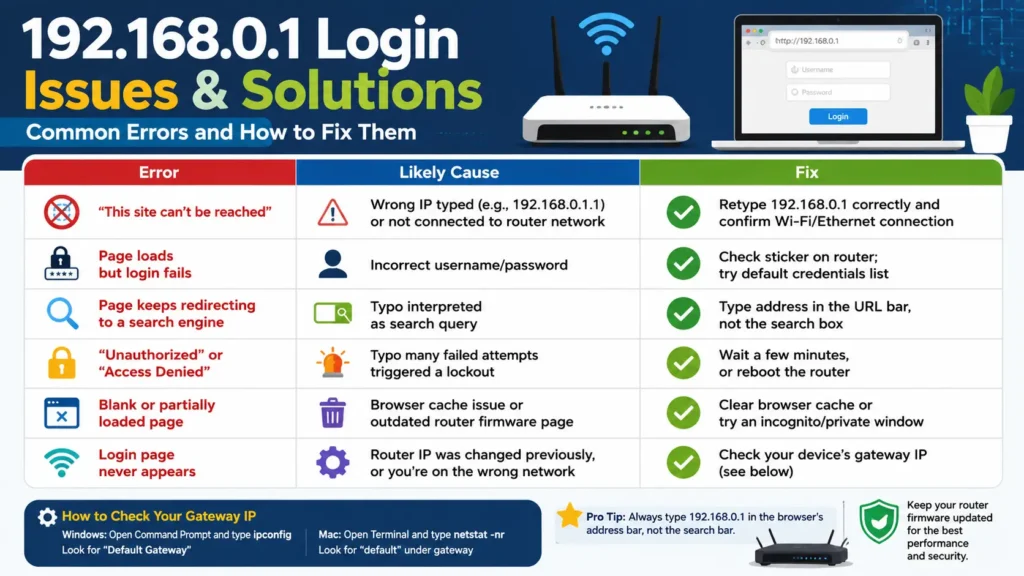
Common Login Errors and How to Fix Them
How to Find Your Router's Actual IP Address
If 192.168.0.1 doesn't work, your router may use a different default gateway. Based on common troubleshooting cases, nearly a third of "login page won't load" issues come down to the router simply using a different default address than the one being typed.
On Windows:
- Open Command Prompt
- Type
ipconfigand press Enter - Look for "Default Gateway" — that's your router's IP
On Mac:
- Open System Settings > Network
- Click on your active connection > Details
- Look for "Router" — that's the IP address you need
On a smartphone:
- Go to Wi-Fi settings
- Tap the connected network's info/gear icon
- Look for "Router" or "Gateway"
What You Can Do Inside the Admin Panel
Once logged in, you'll find a dashboard with a wide range of configuration options. Some are essential for everyday users, others are more advanced.
Beginner-Friendly Settings
- Wi-Fi network name (SSID) — rename your network
- Wi-Fi password — set or change your wireless password
- Guest network — create a separate network for visitors
- Parental controls — restrict access by device or time
Intermediate and Advanced Settings
- WAN/LAN configuration — manage how your router connects to your internet provider and local devices
- WLAN settings — fine-tune wireless channels, bandwidth, and frequency bands (2.4GHz/5GHz)
- DHCP settings — control how IP addresses are assigned to devices on your network
- Port forwarding — open specific ports for gaming, servers, or remote access
- QoS (Quality of Service) — prioritize bandwidth for specific devices or applications
- MAC filtering — allow or block devices based on their hardware address
- WPS (Wi-Fi Protected Setup) — enable quick device pairing via button press or PIN
- Proxy settings — configure network-level proxy routing
- Firmware updates — check for and install the latest router software
Most home users only ever touch the first group. But if you're troubleshooting a slow connection, setting up a smart home device, or trying to improve security, the advanced tab is where the real control lives.
Forgot Username or Password? Here's What To Do
This happens more often than most people expect. Commonly reported cases suggest that a meaningful percentage of users only log in to their router once — during setup — and forget their credentials within the first year.
Here are your options, in order of how disruptive they are:
Option 1: Check the Router Label
Flip your router over. Most units have a sticker listing the default username, password, and sometimes the default Wi-Fi network name and key.
Option 2: Try Common Default Credentials
Many routers ship with simple defaults like:
- Username:
admin/ Password:admin - Username:
admin/ Password:password - Username:
admin/ Password: (blank)
If you're unsure of your specific brand's defaults, check a default router username and password reference list for your exact model.
Option 3: Recover Without Resetting
Some newer routers offer a "Forgot Password" or account-recovery option tied to an app or cloud account (common with mesh systems and newer smart routers). If your router has a companion app, check there first.
Option 4: Factory Reset (Last Resort)
If nothing else works, you can reset the router to its factory defaults:
- Locate the small reset button (often recessed, requiring a pin or paperclip)
- Press and hold it for at least 10 seconds
- Wait for the router to reboot (lights will flash, then stabilize)
- Log in again using the default credentials from the label
Important: A factory reset erases all custom settings — including your Wi-Fi name, password, and any port forwarding or parental control rules you had set up. You'll need to reconfigure everything from scratch.
How to Change Your Wi-Fi Password Safely
An unsecured or weak Wi-Fi password is one of the most common ways personal data gets exposed to unwanted access. Based on frequently observed patterns, routers still using their factory-default password are disproportionately represented in unauthorized-access incidents on home networks.
Changing it is simple. Here's how:
Step-by-Step Guide
- Open your browser and go to
http://192.168.0.1(not 192.168.0.1.1). - Log in using your admin username and password, found on the router's label.
- Navigate to the Wireless tab on the dashboard.
- Find "Wireless Security" (naming varies slightly by brand — look for anything mentioning "security" or "password").
- Enter your new password. Some routers ask you to type it twice to confirm.
- Create a strong password:
- Use at least 12–16 characters
- Mix upper and lowercase letters
- Include numbers and symbols like
#,!,& - Avoid real words, birthdays, or names
- Consider a reputable password generator for a truly random string
- Save your changes. The router may briefly reboot the wireless radio.
- Reconnect your devices using the new password.
A Note on Remembering Your New Password
Write it down temporarily if you need to, but aim to memorize it. A useful trick: base your password on a personal phrase only you'd recognize, then apply consistent substitutions (letters to numbers, added symbols). That way, even a written note won't mean much to someone else, but it'll jog your memory instantly.
If you do forget it later, remember: the only way back in without the password is a full factory reset, which brings you back to square one on all settings.
192.168.0.1 vs Other Common Router IPs
| IP Address | Common Use | Typical Brands |
|---|---|---|
| 192.168.0.1 | Most common default gateway | TP-Link, D-Link, some Netgear models |
| 192.168.1.1 | Second most common default | Cisco, Linksys, some Netgear/Belkin models |
| 192.168.0.1.1 | Not valid — common typo | N/A |
| 10.0.0.1 | Alternative default used by some ISPs | Some AT&T, Xfinity/Comcast gateways |
| 192.168.2.1 | Used by some mesh systems | Certain Netgear Orbi/mesh configurations |
If 192.168.0.1 doesn't load your login page, check this table against your router's label or use the ipconfig / network settings method described earlier.
Router Brands That Use 192.168.0.1
While defaults can vary by model and firmware version, 192.168.0.1 is commonly the default gateway for:
- TP-Link (many Archer and standard router series)
- D-Link (most consumer models)
- Netgear (select models — always check your label)
- Zyxel (select models)
- Some ISP-provided modem-router combo units
Always verify against the sticker on your specific unit, since manufacturers occasionally change defaults across firmware versions or regional releases.
Security Best Practices for Router Admin Access
Getting into the admin panel is only half the job — keeping it secure matters just as much. Based on common industry observations, routers left on factory-default admin credentials are a recurring theme in home network compromise reports.
- Change the default admin password, not just the Wi-Fi password. Many users secure their Wi-Fi but forget the admin login itself is still "admin/admin."
- Disable remote management unless you specifically need it — this prevents access attempts from outside your home network.
- Keep firmware updated. Manufacturers regularly patch security vulnerabilities.
- Use WPA3 encryption if your router supports it (WPA2 is the minimum acceptable standard today).
- Turn off WPS if you don't use it — it's a known weak point for brute-force attacks.
- Review connected devices periodically through the admin panel to spot unfamiliar entries.
- Set up a guest network for visitors and smart home devices so they're isolated from your main network.
FAQs About 192.168.0.1.1 Admin Login
Is 192.168.0.1.1 a real IP address?
No. IPv4 addresses use exactly four numbers separated by dots. 192.168.0.1.1 has five numbers, making it invalid — it will never load a router login page.
What is the correct IP for router login?
For most home routers, it's 192.168.0.1. Some routers use 192.168.1.1 instead. Check the label on your router or your device's network settings to confirm.
Why does 192.168.0.1 redirect to a search engine instead of my router?
This usually happens when the address is typed into the browser's search bar instead of the URL/address bar, or when there's a small typo in the address.
What do I do if I forgot my router's admin password?
First, check the label on the router itself. If that doesn't work, try common default credentials, or as a last resort, hold the reset button for at least 10 seconds to restore factory settings.
Does resetting my router delete my Wi-Fi password too?
Yes. A factory reset erases all custom settings, including your Wi-Fi name and password, returning the router to its out-of-box defaults.
Can I access my router's admin panel from outside my home?
Only if remote management is specifically enabled in the settings — and for security reasons, most experts recommend keeping this feature disabled unless absolutely necessary.
Why can't I connect to 192.168.0.1 at all?
Common causes include not being connected to the router's network, a different default gateway IP for your specific router model, or a browser cache issue. Try the ipconfig/network settings method to confirm your actual gateway address.
How often should I change my Wi-Fi password?
There's no strict rule, but changing it periodically — and immediately after sharing it with guests you no longer want connected — is a commonly recommended practice for maintaining network security.
Is WPS safe to use for connecting new devices?
WPS is convenient but considered a weaker security option due to known vulnerabilities in some implementations. Many security-conscious users disable it and connect devices manually instead.
What's the difference between the router's IP and my Wi-Fi password?
The IP address (like 192.168.0.1) is the web address used to reach the admin login page. The Wi-Fi password is what devices use to join your wireless network — they're two completely separate things.
Conclusion
The bottom line: 192.168.0.1.1 doesn't exist as a functional IP address, and no amount of retrying will make it load your router's login page. The correct address for most home routers is 192.168.0.1, and once you're in, you have full control over your network's Wi-Fi name, password, security settings, and more.
Key takeaways:
- Always type
192.168.0.1, not192.168.0.1.1, into your browser's address bar - Check the label on your router for default login credentials
- If the default IP doesn't work, confirm your actual gateway address via
ipconfig(Windows) or network settings (Mac/mobile) - Change both your Wi-Fi password and admin password to something strong and unique
- Use a factory reset only as a last resort, since it erases all custom settings
A few minutes spent getting this right protects your entire home network — and now you know exactly how to do it.